
Truth: A Blog
No, Senator McConnell, History Is Not On Your Side In Filling Justice Ginsburg’s Seat
Abraham Lincoln Waited. We Should Too.
by Andrew Y. Brownsword, 9/25/2020
Even before Justice Ruth Bader Ginsburg died on Friday, September, 18 – less than 7 weeks before Election Day – Senator Mitch McConnell (R-Kentucky) and his supporters were playing the game. When given the opportunity, they said, historical precedent supported filling a Supreme Court vacancy in a Presidential election year when the same party controlled both the White House and the Senate. They confidently proclaimed that 19 times Presidents tried to “fill a vacancy” in an election year when a single party held such power and it almost always succeeded. The People had spoken in past elections giving the GOP control of the Senate in 2014 and the Presidency in 2016. Nothing else mattered in this game.
Picking up on the theme of the game, CNN.com ran a story on September 22 with the headline “Mitch McConnell is Going to Win (Again).” But, as usual, Senator McConnell is trying to win a game where only he writes the rules, and he hopes no one checks him.
Let’s check his rules, shall we?
Rule number one – “…filling a vacancy in a Presidential election year…” The GOP’s analysis of the historical record inexplicably includes vacancies that occurred or were filled the year before the election year AND through to Inauguration Day the following year, which for much of America’s history happened in early March. So, in their game, an election year actually lasts more like 18 months. Nine (9) of their 19 vacancies were filled after Election Day. Of course, a year is only 12 months and it is fair to say that an election year is only 10 months, January through early November.
Rule number two – “…The White House and the Senate were controlled by the same party…” This rule supposes that America has always had the deep, dark partisan divide that it suffers from right now… on all issues. If that was the case, you would expect to see very contentious votes in the Senate on all of these election year nominations with the minority party voting no. Instead, 13 of their 19 examples were confirmed with unanimous or near-unanimous votes. You see, for much of our history Supreme Court justices were nominated because of the quality of their jurisprudence, their independence and their work ethic rather than along partisan lines. Unanimous votes were not uncommon.
Rule number three – “…the People had spoken in past elections…” This rule, of course, greatly generalizes the political conditions that exist at any one time. The current Senate majority was won in 2014 – almost 6 years ago. The Democrats have chipped away ever since including a net gain of seats in the year Donald Trump was elected and they have a great chance at winning back the Senate this year. And, while it may not be strictly relevant, the GOP lost the last “national” election for control of the House of Representatives in 2018 in spectacular fashion based on unprecedented turnout for the Democrats. On November 3rd, the People will vote again and the Republicans will likely lose.
So Senator McConnell’s rules are, in one case, misleading (18 month year) and in all cases self-serving.
The old saying goes “rules are made to be broken.” But as any sports league will tell you the more accurate phrase is “rules are made to be changed.” So let’s change just one of Senator McConnell’s rules. What does history say about filling Supreme Court vacancies that occur during a Presidential election year from January to November when the same party controls the Presidency and the Senate?
By changing this one rule, the number of cases to consider drops from 19 to only 7. That’s not many. Let’s look at those 7 cases on a calendar to see just how much our current situation with Justice Ginsburg’s seat matches with historical precedent.
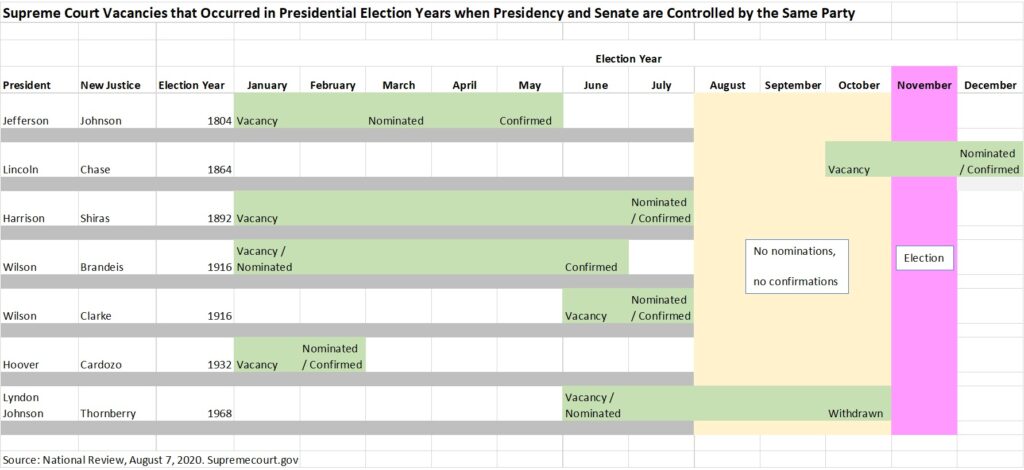
In four (4) of these cases, the vacancies occurred in January of the Presidential election year. All of their replacements were confirmed by July and 3 of them were confirmed unanimously within days of their nomination (read rule #2 above). Interestingly, the only one who was not confirmed so quickly and so easily was Justice Louis Brandeis, the first Jewish-American to serve on the Supreme Court nominated by Democrat Woodrow Wilson in 1916. Justice Brandeis faced staunch opposition due to his views on social justice issues and he was opposed in his confirmation votes by almost all of the Republicans in the Senate.
In two (2) of these cases, the vacancies happened in June. One of them, Justice John Clarke, another 1916 nomination by President Wilson, was confirmed a month later unanimously and within days of his nomination. The other, Justice Homer Thornberry, withdrew his nomination when President Lyndon Johnson’s simultaneous nomination of Abe Fortas from Associate Justice to Chief Justice could not pass a Republican and Conservative Southern Democrat filibuster.
And in only one (1) case did a vacancy occur in a Presidential election year when the same party controlled the White House and the Senate as late as Justice Ginsburg’s. Justice Roger Taney, the dreadful justice behind the Dred Scott decision forbidding slaves who had lived in free territories to sue for their freedom, died on October 12, 1864. Abraham Lincoln was President. Lincoln did not name Taney’s successor, Salmon Chase, until December when he had already been re-elected. Chase was confirmed unanimously on the same day he was nominated.
Other than Justice Taney, a Supreme Court vacancy has never occurred as close to a Presidential Election Day as Justice Ginsburg’s when the White House and the Senate were controlled by the same party. And President Lincoln waited.
On September 22nd, Senator Mitt Romney (R-Utah) issued a statement that read, in part, “[My decision] is based on the immutable fairness of following the law, which in this case is the Constitution and precedent… I intend to follow the Constitution and precedent in considering the President’s nominee.” This statement made it clear that Senator McConnell has the votes to confirm whoever President Trump nominates to replace Justice Ginsburg.
Yes, the Constitution does not prohibit the President and this Senate from filling Justice Ginsburg’s seat. But, history does not support granting a lifetime appointment to the Supreme Court within weeks if not days of the People exercising their vote. Lincoln is the only President who had the chance and he waited.
In another story on CNN.com from September 22nd, Senator Susan Collins (R-Maine) said “It is just too close to the election.” Senator Collins, who often says the right thing, is exactly right. It is just too close.